
How Much Does SSD Data Recovery Cost?
The honest answer is that it depends on what went wrong inside the SSD, and on what has happened to it since. Two drives that both “just disappeared” can be very different jobs: one has a failed connection or power circuit and the flash is untouched, while the other has a controller that lost its internal map, or died with the encryption key locked inside it. That is why the best first step is a short, no-pressure call with one of our tech advisors, who can give you a realistic idea of what your recovery is likely to involve before anything ships.
What will your SSD recovery cost?
Call a tech advisor for a friendly, no-pressure conversation. Tell us the drive and the symptoms and we’ll give you a realistic idea before you send anything.
This page explains what shapes the cost of an SSD recovery, why some SSD cases take far more engineering than others, what you can do right now to keep a routine case routine, and how to get a firm number. For how pricing works across every kind of device, see our overview: how much does data recovery cost?
Why SSD Recovery Is Specialist Work
An SSD has no moving parts, so people expect recovering one to be simple. It rarely is. You are hiring a scarce specialist who may spend several days of engineering work on one drive, backed by a lab, specialized equipment and years of research into how individual SSD controllers store and protect data. There are far fewer data recovery engineers in the country than there are lawyers, and even a small project handled by a junior associate at a law firm runs into the thousands.
Every case carries a small share of what it takes to run the lab: the cleanroom, the equipment, and the experienced engineers and staff. On top of that, an SSD quote comes down to how much engineering time the recovery needs, what parts or tooling it needs, and how feasible it is. On SSDs, those things are decided mostly by which of the situations below you are in.
What Determines the Cost of an SSD Recovery
Connection, port or power faults
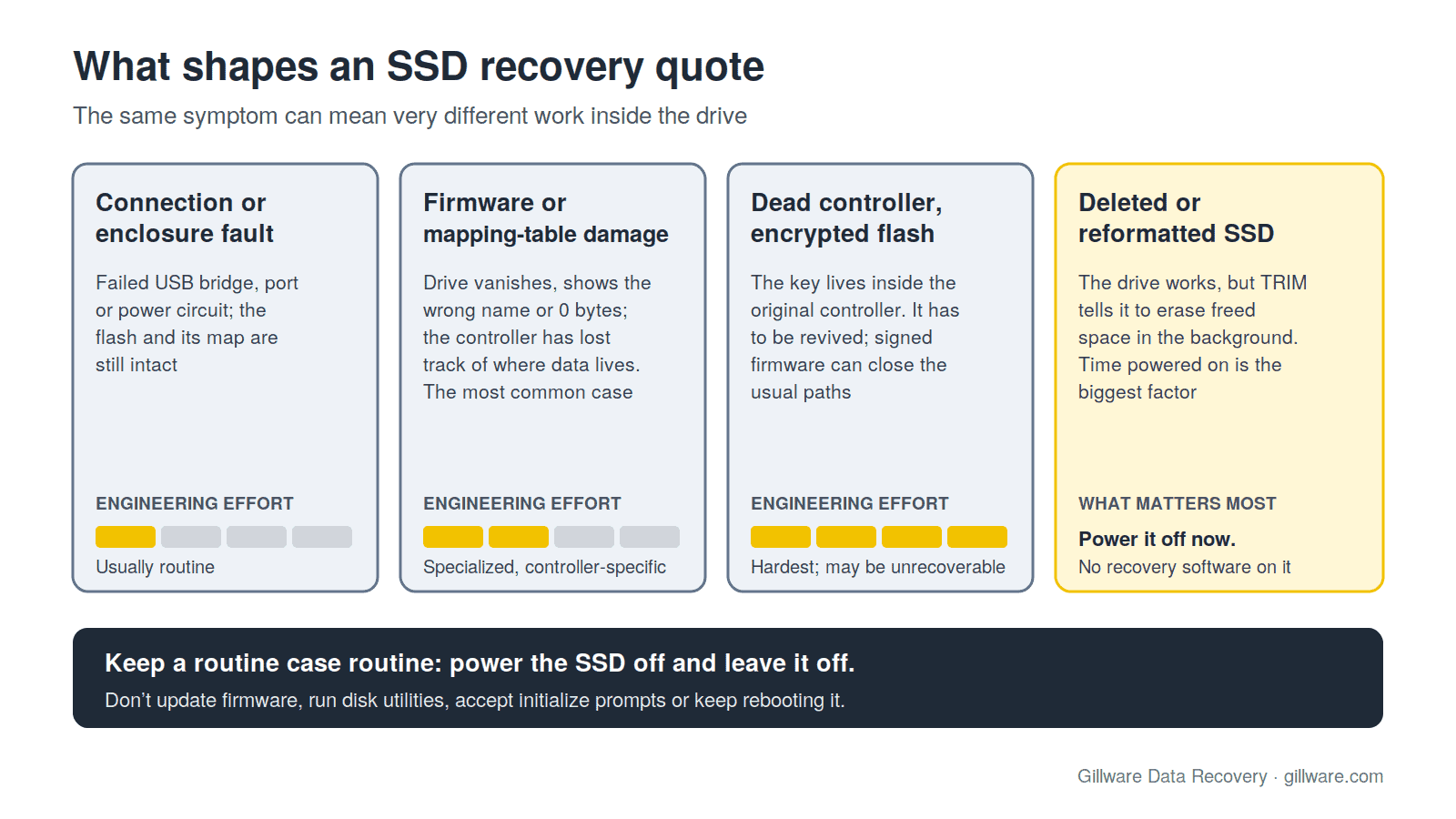
Sometimes the flash memory and the controller are fine and something around them failed: the USB bridge in an external SSD, a damaged connector, or a power component on the board. These cases still need care and the right tools, but the data and the drive’s internal map are intact. They tend to sit at the routine end.
Firmware and mapping-table corruption
This is the most common SSD failure we see. Every SSD keeps an internal map that tells its controller where each piece of your data physically lives in the flash. When that map or the drive’s firmware is damaged, often by a power loss at the wrong moment or a firmware defect, the drive vanishes from the computer, shows up under the wrong name, or reports a capacity of 0 bytes. The data is usually still there; the drive just no longer knows where anything is. Recovering it means rebuilding access through that specific controller family: specialized work.
A dead controller and encrypted flash
Almost every modern SSD encrypts data before writing it to flash, whether or not you ever set a password, and the key lives inside the original controller. If the controller cannot be brought back, reading the memory chips directly yields scrambled data. Many manufacturers also sign their firmware, which closes off some of the older ways labs used to reach a stuck drive. We will say this plainly: some SSD failures need research and tooling specific to one controller, which makes them expensive, and a few are not recoverable at any price because the key is gone with the controller. We tell you which situation you are in after a real evaluation, not from a guess over the phone. Our SSD data recovery page explains this in more detail.
Deleted files or a reformatted SSD
Sometimes the drive works perfectly and the problem is that files were deleted, the drive was reformatted, or an operating system was installed over it. On SSDs, a feature called TRIM tells the drive to erase freed space in the background, often within minutes. The longer the drive stays powered on, the less there is to recover. If this is your situation, power the SSD off now and do not run recovery software on it.
What Can Make an SSD Case Harder
An SSD often gets harder to recover because of what was done after it failed:
- Rebooting again and again to see if the drive comes back. Every power-up gives a confused controller another chance to write to damaged areas.
- Updating the firmware on a drive that is already misbehaving. On a failing SSD, a firmware update can overwrite the very structures a recovery depends on.
- Accepting a prompt to initialize or format the drive. On an SSD, that can trigger TRIM across the whole drive.
- Running recovery software or disk utilities. They cannot fix a firmware or controller problem, and on a deleted or reformatted SSD every minute powered on works against you. Our article on what to do with a corrupted SSD explains why.
The single best thing you can do to keep the cost of an SSD recovery down is to power the drive off at the first sign of trouble and leave it off.
Does the Type of SSD Matter?
The form factor matters less than the controller inside. A 2.5-inch SATA SSD, an M.2 NVMe stick and an external portable SSD can all use controllers we know well, or ones that need more research. Brand matters for the same reason; our guides to Samsung, WD and SanDisk and Crucial SSDs cover the models we see most. In many newer laptops, including MacBooks, the storage is soldered to the main board and tied to its security chip, so the whole computer has to come in. See laptop data recovery and MacBook data recovery.
Capacity matters less than people expect. The hard part is getting the drive readable again, not copying files, so we quote each case on its own merits rather than per gigabyte.
How to Get Your Number
- Call a tech advisor. Tell us the drive model if you know it, what it is doing (not detected, wrong name, 0 bytes, read-only, wiped), what happened just before, and whether anything has been tried.
- Send the SSD in for a free evaluation. Our engineers diagnose exactly what failed and what can be recovered. The evaluation is real engineering work, and it is free.
- Approve a firm quote, or don’t. Every case is quoted after a free evaluation, so you know the cost before any recovery work begins. You decide, and you only pay if we meet your recovery goals.
We quote each case on its own merits, based on what we find in the lab and the thousands of similar cases we have seen with the same equipment and symptoms.
Why Gillware
Gillware has been recovering data for more than two decades, from our lab in Madison, Wisconsin, and more than 1,500 IT professionals nationwide refer their clients to us. Our highly experienced engineers strive for the highest success rates in the industry, and we will always be straight with you about what your SSD needs and whether it can be recovered.
SSD Recovery Cost FAQ
Can you tell me the cost over the phone?
A tech advisor can give you a realistic idea once they know the drive and the symptoms. The firm quote comes after the free evaluation, because that is when we know exactly what failed.
Is the evaluation really free?
Yes. There is no charge to evaluate a single SSD, and you are under no obligation to go ahead.
What if my SSD can’t be recovered?
We tell you plainly after the evaluation. You only pay if we meet your recovery goals.
My SSD is in a RAID array, server or NAS. Is that priced the same way?
Multi-drive systems are handled as business cases and start with a free technical consultation with one of our enterprise storage engineers. See RAID data recovery.
Need a real number for your SSD? Let’s talk.
Our highly experienced engineers strive for the highest success rates in the industry. Send us the device and we’ll diagnose it for free.
- More than 20 years recovering data from failed drives
- Trusted by 1,500+ IT professionals nationwide
- Whatever failed, we’ve seen it hundreds of times
- Pay only if we meet your recovery goals