
Dell Server Data Recovery
If your Dell server is down, you already know the cost. Every hour of downtime means lost revenue, stalled operations, and — depending on what you store — compliance exposure. Whether it’s a PowerEdge with a failed RAID 5, an EqualLogic SAN that won’t mount, a PowerVault array stuck on a foreign configuration prompt, or a Compellent system with a crashed virtual disk, the recovery path depends on diagnosing the failure accurately and acting before someone makes it worse.
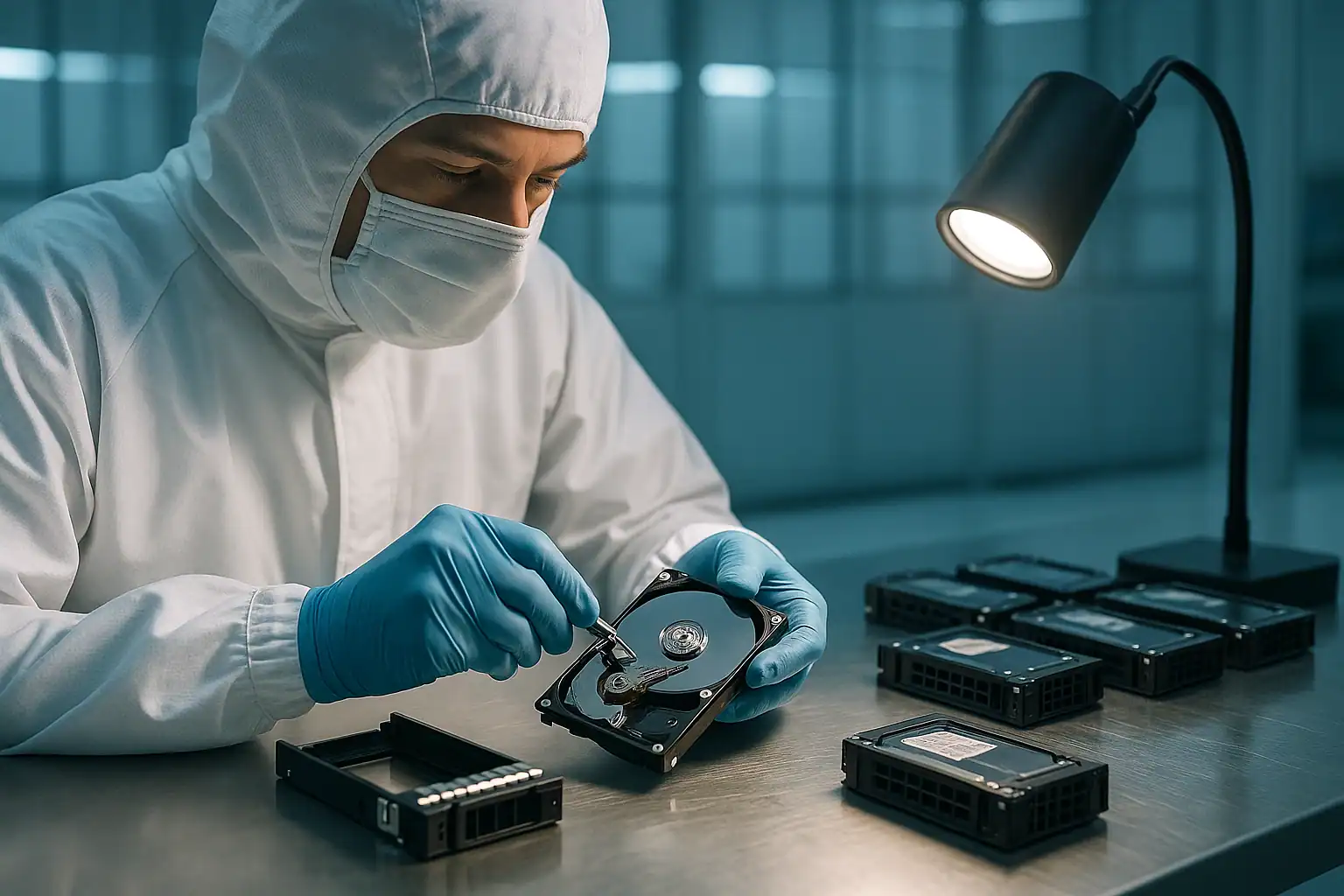
Gillware has been recovering data from Dell servers since 2004. Our engineers work with the full PowerEdge lineup — from older 12th and 13th generation rack servers still running in small business environments to the latest 16th-gen production systems — along with EqualLogic iSCSI SANs, PowerVault DAS arrays, Compellent / SC Series SANs, and PowerStore enterprise storage. We handle the full chain: temporary hardware repairs in our ISO 5 cleanroom, write-blocked forensic imaging, RAID reconstruction, and file-system extraction.
This page walks through the Dell server product lines we support, the failures we handle most often, and how to engage with our server team — as part of our broader server data recovery services. Every Dell server recovery starts the same way: with a free consultation where we talk through your specific scenario and tell you honestly what’s possible.
Dell Server Product Lines We Recover
Dell makes server-class hardware across several product families, each with its own architecture, RAID controllers, and common failure modes. We’ve handled them all.
Dell PowerEdge
The PowerEdge line is Dell’s flagship server family — rack-mount and tower servers powering small businesses, enterprises, and data centers worldwide. The R-series (rack) and T-series (tower) PowerEdges sold between 2016 and 2022 are the systems we see most often in active failure today: 4-10 years of continuous operation, RAID controllers and drives that are starting to age out, and a generation of small business customers who never had robust backup strategies.
We handle the entire PowerEdge family: R230, R330, R430, R530, R630, R730, R730xd, R740, R740xd, R840, R940, T130, T330, T430, T440, T630, T640, and beyond. The most common failures we see involve PERC RAID controller errors, multiple drive failures in RAID 5 arrays, foreign configuration issues after motherboard or controller replacement, and backplane signal degradation in older chassis.
Read about our PowerEdge data recovery process →
Dell EqualLogic
EqualLogic PS-series iSCSI SAN arrays were Dell’s mid-market enterprise storage solution from 2008 through the discontinuation announcement in 2017. Many EqualLogic systems are still in active production at small businesses and education customers. Common failure modes include controller failures (especially on older PS4100, PS6100, and PS6500 systems), accidental volume deletion, group manager corruption, and complete array crashes after firmware updates or extended power events.
Recovering EqualLogic data requires specific expertise — the proprietary group manager and volume layout means commercial recovery tools generally can’t read EqualLogic disks directly. We’ve recovered data from EqualLogic arrays where multiple drives failed, where controllers became unresponsive, and where customers were facing complete group failures.
Read about our EqualLogic data recovery process → · See a real EqualLogic PS4100 recovery case study →
Dell PowerVault
PowerVault is Dell’s direct-attached storage (DAS) line — JBOD and RAID enclosures connected to a PowerEdge server via SAS or other interfaces. PowerVault models we recover from regularly include MD3000, MD3200, MD3220, MD3400, MD3420, ME4012, ME4024, and ME5012/ME5024 arrays. Common failures: multiple drive failures in a RAID 5 or RAID 6, controller module failures, expansion shelf issues, and the same foreign configuration scenarios that plague PowerEdge servers when controllers or hosts change.
Read about our PowerVault data recovery process →
Dell Compellent / SC Series
The Compellent SC-series storage arrays (later rebranded as Dell SC) are enterprise SANs targeting mid-market and large enterprise customers. Common failure scenarios include controller node failures in clustered configurations, deleted volumes, snapshot chain corruption, and storage pool integrity issues. Compellent systems use a proprietary architecture that requires specialized recovery work — we have the tooling and expertise to extract data from failed Compellent arrays when standard support paths have been exhausted.
Dell PowerStore and Other Modern Storage
Newer Dell storage products including PowerStore, PowerScale (formerly Isilon), and Unity XT are increasingly common in our caseload. While these are newer systems, they’re not immune to multi-drive failures, configuration corruption, or accidental deletion events. Recovery work on modern Dell storage is more specialized but follows the same fundamental process: forensic imaging, controlled reconstruction, file-system extraction.
Why Dell Servers Are Failing in 2026
Three patterns drive the bulk of the Dell server recovery work we see right now:
Hardware aging out of mainstream service life. The Dell PowerEdge servers sold between 2016 and 2022 are now 4-10 years old. Drives are approaching their failure curves. PERC controller batteries are degrading. Backplane connectors are oxidizing. Small business customers who deployed these systems often haven’t refreshed them on Dell’s recommended schedules and haven’t been monitoring for early warning signs. The systems are reaching the part of their life where multiple components fail in quick succession.
End of Dell support contracts for older generations. 12th generation (R720, R620, T620, etc.) PowerEdge servers are well past Dell’s standard support window. 13th gen (R730, R630, T630, T430, etc.) coverage is also winding down. When something fails and the customer doesn’t have an active contract, the path to resolution narrows quickly.
Small business “set it and forget it” deployments. A large portion of our Dell server cases come from organizations that deployed a server 6+ years ago and have done minimal maintenance since. Predictive failure alerts have been firing for months and being ignored. SMART warnings are buried in logs no one reads. Then a second drive fails in the RAID 5, and suddenly the business is in crisis mode.
How Our Dell Server Recovery Process Works
This is the work we’ve been doing for over 20 years. Our process has five distinct stages.
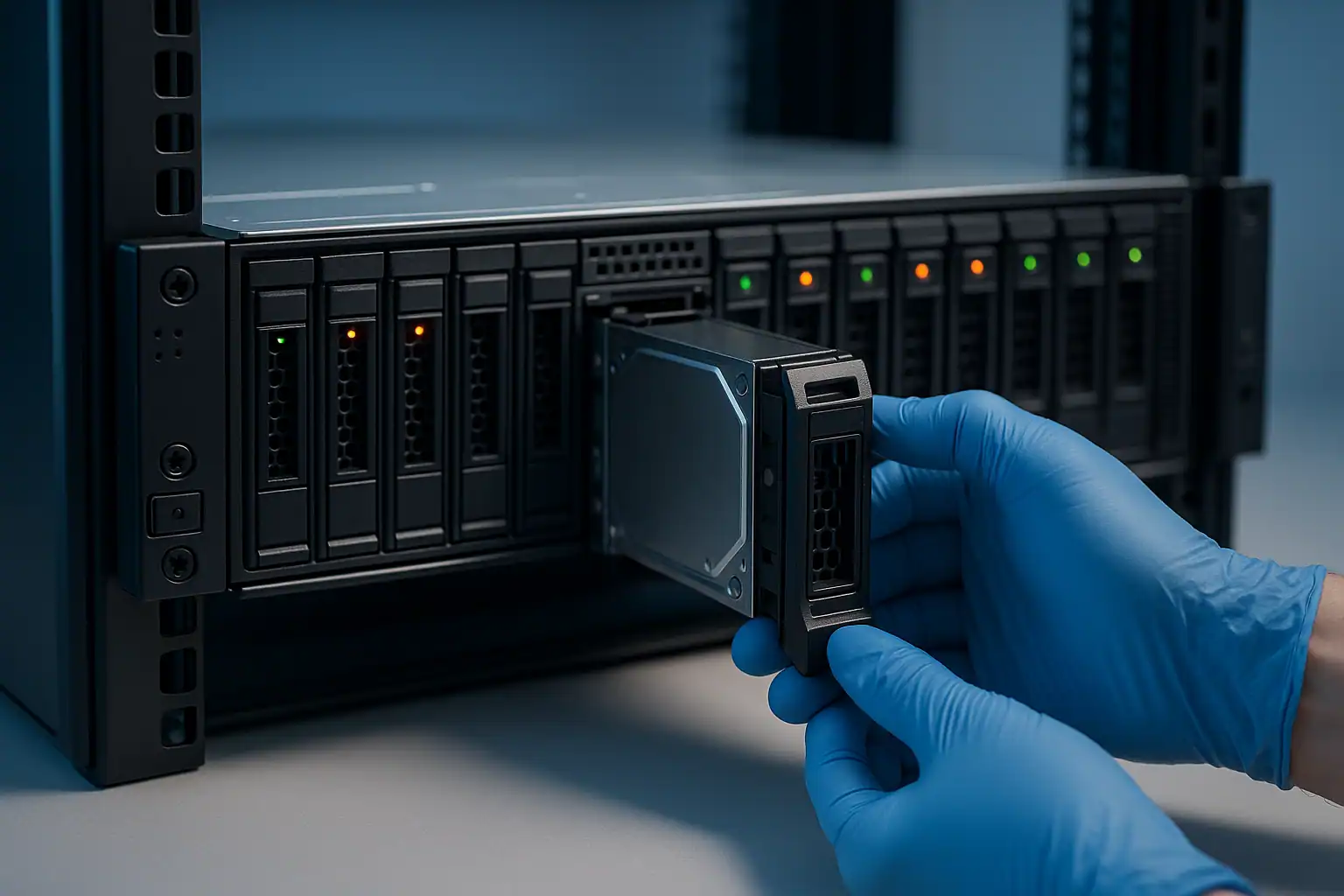
Step 1: Free consultation and case scoping
Every Dell server recovery starts with a conversation with our server team. We need to understand the specifics: what model server, what RAID configuration, what failed and in what order, what’s been attempted, and how critical the data is. The consultation is free. From it, we determine scope, feasibility, and engagement structure. For larger enterprise jobs involving many drives, extensive engineering time, or specialized work, we provide a clear upfront quote based on projected hours.
Step 2: Temporary hardware-level repairs
For drives with mechanical or electronic failures, our engineers perform temporary repairs in our ISO 5 Class 10 cleanroom: head transplants, PCB repairs, firmware adjustments. These repairs aren’t meant for long-term operation — only to make the drive readable long enough to capture a clean image. Enterprise SAS drives common in Dell servers (Seagate Constellation, Cheetah, Exos; Western Digital Ultrastar; HGST series) have specific firmware and hardware quirks our engineers know intimately.
Step 3: Write-blocked forensic imaging of every drive
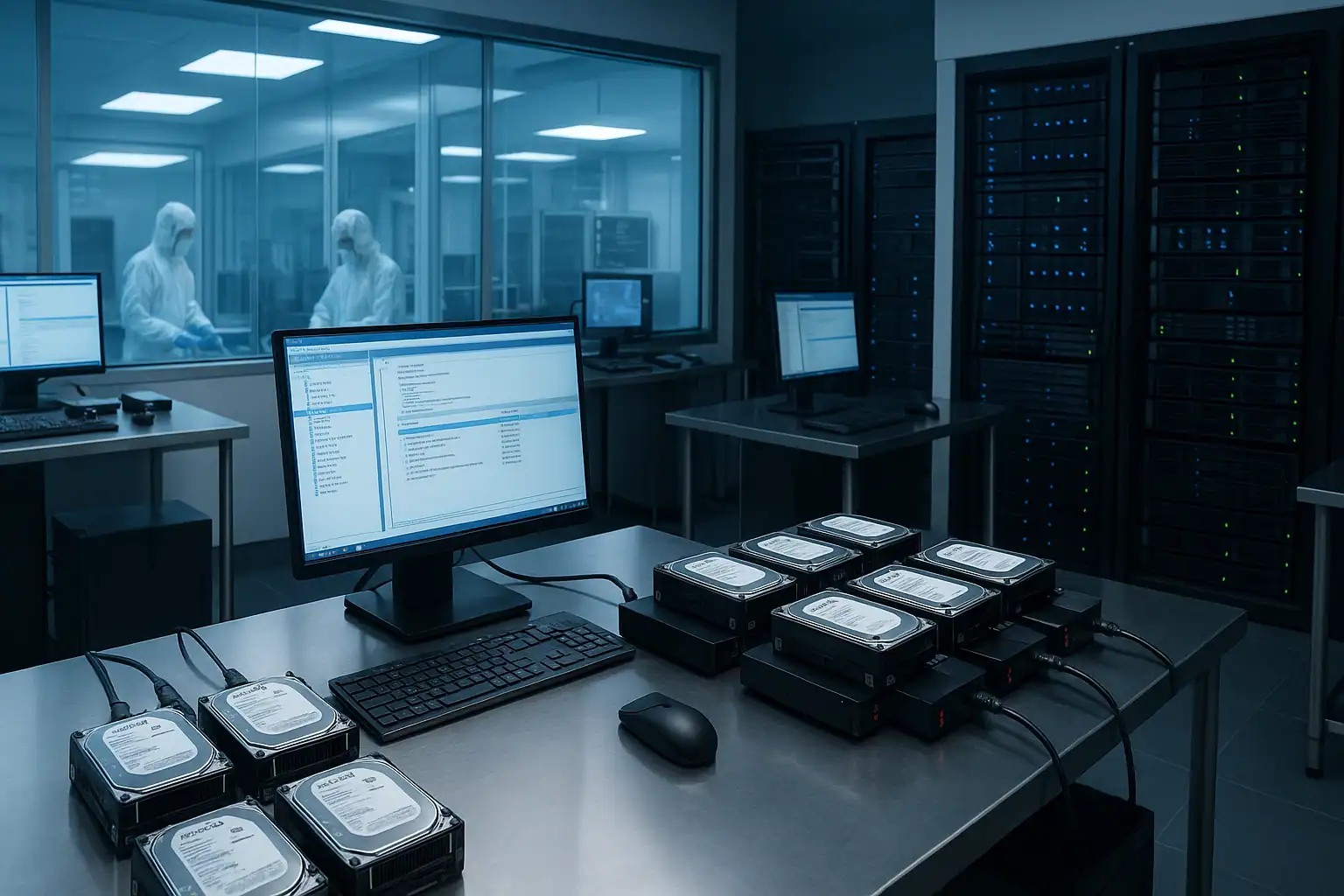
We connect each drive in the array through a hardware write-blocker and capture a bit-for-bit forensic image. This applies to every drive — including the ones that “failed” — because RAID reconstruction requires all surviving members. The original drives are never written to. Every subsequent step happens against the images. If anything makes the situation worse, we roll back to the baseline.
Step 4: RAID reconstruction with Hombre
Our proprietary tool, Hombre, performs the work of a PERC controller in software — but with capabilities no Dell controller offers. Hombre analyzes the RAID metadata on each drive, identifies stripe size, parity rotation, drive order, and offset, and reconstructs the logical volume even when:
- The original PERC controller is dead or unavailable
- Drives were removed in unknown order and the configuration was never documented
- One or more drives are partially unreadable (Hombre uses parity from other drives to recompute missing data when possible)
- Multiple drives are out of sync with each other from cascading failures
- A foreign configuration import attempt failed or was performed incorrectly
Step 5: File system extraction
Even after the array is reconstructed, the file system on top often won’t mount — corrupted metadata, damaged journals, missing critical structures. Hombre parses NTFS, ReFS, ext4, XFS, VMFS, and other file systems directly without mounting them, building a forensic database of every file the volume contained. From that database we extract individual files, VMs, database tables, and mailboxes even when the volume itself is unbootable.
What to Do Right Now If Your Dell Server Is Down
The first hour of a Dell server failure is the most critical. The wrong actions in that hour can turn a routine recovery into a difficult or impossible one.
Don’t accept any “foreign configuration” prompt without thinking carefully. If a PERC controller is asking whether to import or clear a foreign configuration, the wrong answer can destroy the array irreversibly. When in doubt, leave the system at the prompt and call us before making a choice.
Don’t initiate a rebuild on a degraded array unless you’re confident it will succeed. A rebuild reads every sector of every surviving drive. If any surviving drive has even a few bad sectors, the rebuild can fail catastrophically — or worse, “succeed” with a puncture that permanently writes zeros to data you needed.
Don’t run filesystem repair tools. chkdsk, fsck, and vendor “repair” utilities can permanently alter metadata that recovery depends on. If a volume won’t mount, the right answer is almost never to try to repair it in place.
Document the failure timeline. What you saw in iDRAC, what the drive LEDs are doing, what was tried, in what order, by whom. The more we know going in, the faster the consultation moves and the more accurate our scope estimate.
If drives are making physical noises — clicking, beeping, grinding — power them off and leave them off. Mechanical failures get worse with every minute of runtime.
How Dell Server Recovery Pricing Works
Dell server recovery pricing varies dramatically based on the scope of work. A small PowerEdge T-series with a single failed drive in a RAID 1 is a very different job from a 24-drive PowerVault array with a double-fault RAID 6 condition and a 60TB recovery target. The work scales with drive count, capacity, complexity of the storage architecture, condition of the drives, and time-sensitivity.
Every engagement starts with a free consultation. We use that conversation to scope the work and provide a clear upfront quote before any recovery work begins. The consultation is never billed. For cases that aren’t feasible — typically scenarios involving lost encryption keys, ransomware with unbreakable encryption, or physical destruction beyond recovery — we tell you honestly rather than billing for work that can’t succeed.
Remote and Emergency Server Recovery
Most Dell server recoveries involve shipping the drives or the entire server to our Madison, Wisconsin facility. For situations where shipping isn’t feasible — regulated data, multi-rack systems, international shipping delays — we can sometimes perform on-site or remote recovery. For time-critical failures, our expedited service tier prioritizes your case and dedicates engineers to it. Both options are discussed during the consultation based on your specific situation.
Frequently Asked Questions
Can you recover from a Dell server where someone already attempted a rebuild?
Often yes, depending on what happened during the rebuild. A rebuild that ran briefly before failing usually still leaves recoverable data on the original drives. A rebuild that completed against the wrong configuration, or one that introduced punctures, is more challenging but still often recoverable from the original drive images. Tell us what happened during the consultation and we’ll tell you what’s possible.
What if my PERC controller died and the replacement won’t read the array?
This is one of our most common scenarios. We read the drives directly without depending on the controller, then reconstruct the array in software using the metadata still present on the drives. The controller itself becomes irrelevant.
What about EqualLogic group manager corruption?
Group manager issues, deleted volumes, and complete group failures on EqualLogic are recoverable in many cases. The work is specialized — EqualLogic uses a proprietary architecture — but the same forensic imaging and reconstruction process applies.
Do you handle Dell servers with hardware-encrypted SED drives?
Yes, when we have the keys. Self-encrypting drives commonly deployed in Dell servers (especially in PowerEdge with PERC-managed encryption or Dell’s Local Key Management) follow the same recovery limits as any encryption scheme: if the keys are available, recovery from a failing drive follows the standard process; if the keys are truly lost, the data is not accessible by any legitimate means.
What’s the typical turnaround?
For straightforward cases on smaller arrays, days. For complex cases on large arrays with multiple failures and physical damage, weeks. Our expedited service tier compresses these timelines significantly. The consultation will give you a realistic estimate based on your specific situation.
Do you work with MSPs and IT consultants?
Yes — a substantial portion of our Dell server cases come through MSPs and resellers. We’re comfortable working as a white-label recovery service behind your customer relationship. Mention this during your consultation.
Start Your Free Dell Server Recovery Consultation
If your Dell server is down, every hour matters. Get a free consultation with our server team — we’ll walk through your specific situation, tell you what’s possible, and give you a clear path forward.
Free consultation · Clear upfront pricing · ISO 5 cleanroom recovery
Or call 1-877-624-7206 to speak with our server team directly