
RAID 1 Data Recovery
RAID 1 mirror failed or won’t mount?
Power the array off and don’t attempt another rebuild. Book a free consultation with one of our enterprise recovery experts.
If your RAID 1 mirror has failed and you need the data back, you’ve landed in the right place. RAID 1 is the simplest fault-tolerant RAID level — two disks hold identical copies of the same data, written in lockstep. The intent is that the surviving disk in a mirror keeps working when the other one fails. In practice, RAID 1 failures are usually more complicated than “one drive died, the other is fine.” Gillware has been recovering RAID 1 arrays since 2004 in our ISO 5 Class 100 cleanroom in Madison, Wisconsin. Every case starts with a free consultation with one of our enterprise recovery experts. See also our RAID data recovery hub.
Book a free RAID 1 consultation →
How RAID 1 Works
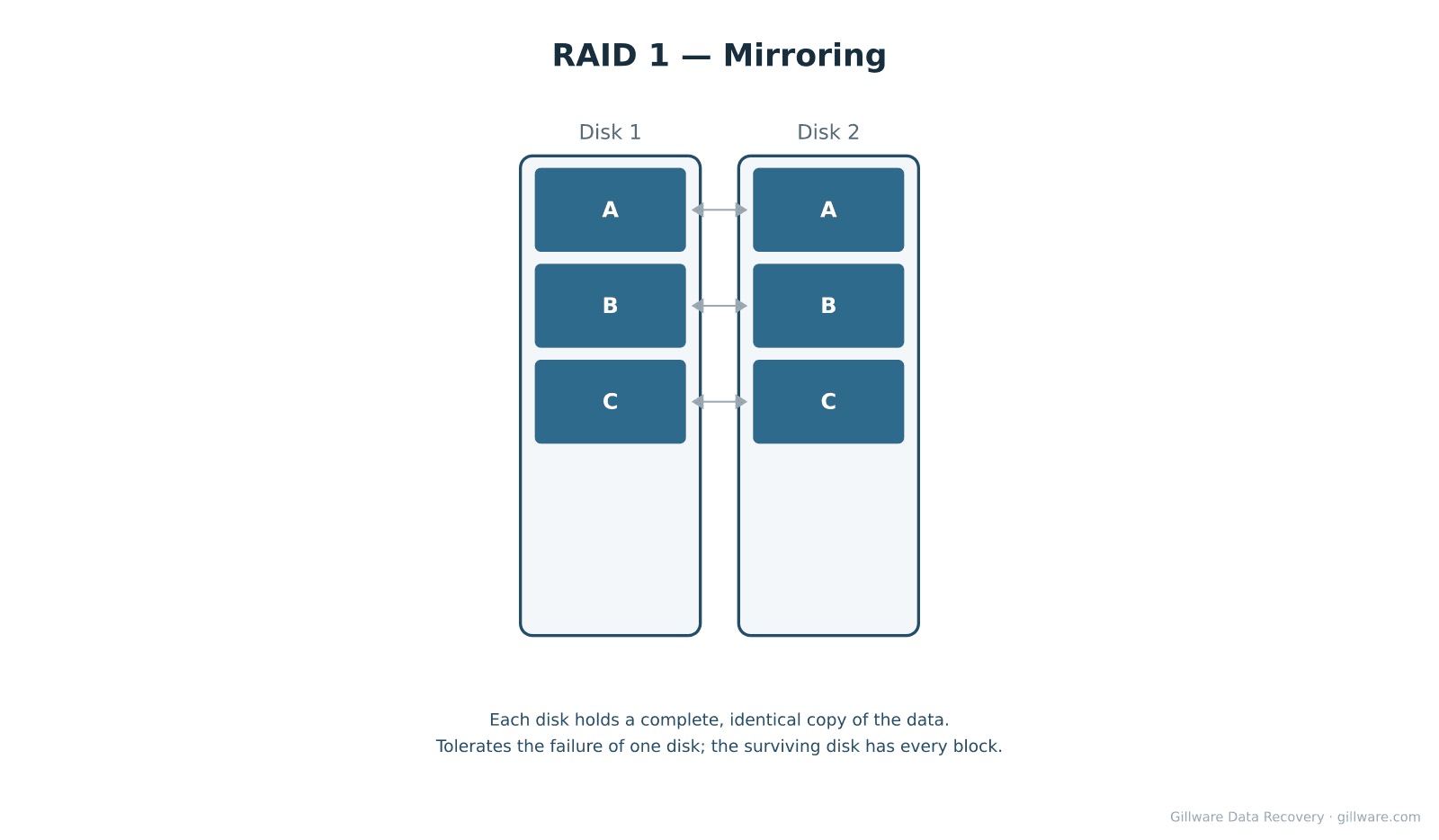
RAID 1 mirrors every write to two disks simultaneously. Each disk holds a complete, byte-for-byte copy of the volume. Reads can be served from either disk (some controllers alternate, some prefer one), but every write goes to both. If one disk fails, the controller marks the array as degraded but continues to serve data from the surviving disk. Replacing the failed disk triggers a rebuild that simply copies the surviving disk’s contents to the replacement.
Why RAID 1 Arrays Fail
Silent failure of one disk, then failure of the other. The classic RAID 1 disaster: one disk fails months ago and nobody notices because the array kept working. Then the second disk fails and the array is fully offline. We see this constantly in small-office mirrors where nobody is watching the health indicators.
Split-brain after a controller event. When a RAID 1 array is split — for example, when one disk is removed for testing, then both are returned to the controller — the controller may not know which copy is current. If both disks have received writes independently before being re-paired, the array contains two different versions of the data. Resolving this requires per-disk timeline analysis.
Mirror desync from firmware or cabling issues. Intermittent connection problems can cause writes to land on one disk but not the other for extended periods, leaving the two mirrors with progressively divergent contents. The controller doesn’t always catch this.
Both disks fail. Less common, but it happens — especially when both disks were purchased together, from the same lot, and were therefore prone to fail in the same window. Recovery depends on whether either disk can be physically repaired.
How We Recover RAID 1
RAID 1 is often the most recoverable RAID level because there are two complete copies of the data to choose from. We image both disks independently in our cleanroom on write-blocked hardware. Physically damaged disks are repaired with donor parts as needed before imaging. Once we have images of both, our engineers compare the two to determine which copy is more current, whether they diverged during a split-brain event, and whether the data on either copy is recoverable to the file level.
If only one disk has any chance of being read — a common case when one drive is completely dead and the second has gradually degraded — we work from the survivor alone. Even partial reads from a degraded disk are often enough to assemble most of the file system because RAID 1 doesn’t depend on cross-disk reconstruction. Once a clean image is available, file-system recovery proceeds normally.
Related RAID Recovery Pages
Other RAID levels we recover: RAID 0 · RAID 5 · RAID 6 · RAID 10 · JBOD. Return to the RAID data recovery hub for the full overview of how Gillware handles RAID, NAS, SAN, and server array recoveries.
Start Your RAID 1 Recovery
If your RAID 1 mirror has failed and the data on it matters, the next step is to book a free consultation. Power the array off, label each disk with its bay position, and ship both disks together — we want to evaluate both copies even if you believe one is dead.
RAID 1 mirror failed? Let’s get your data back.
Our highly experienced engineers strive for the highest success rates in the industry. Talk with one of our enterprise storage engineers before anything else is done to the system.
- Free technical consultation with one of our enterprise storage engineers
- A written recovery agreement before work begins
- No billing surprises: you approve all recovery fees in advance
- Emergency service for business-critical downtime
Prefer to talk to someone first? Call 1-877-624-7206 or schedule a 15-minute consultation with a client advisor.