
How Much Does Data Recovery Cost?
The short, honest answer: it depends on the device, on what failed, and on how hard the recovery turns out to be. A laptop drive with a failed circuit board and an eight-drive server array that someone tried to rebuild are not the same job, and no lab that quotes both the same price is telling you what your recovery actually involves. That is why the honest answer to “how much does data recovery cost?” starts with a short, no-pressure call with one of our tech advisors, who can give you a realistic idea once they know what you have and what happened to it.
Wondering what your recovery will cost?
The honest answer starts with a short, no-pressure call with one of our tech advisors. Tell us the device and the symptoms and we’ll give you a realistic idea before anything ships.
This page explains what goes into a data recovery quote, why expert recovery is priced the way it is, and how to get a number you can actually plan around. If you already know what kind of device you have, the pages below go deeper on each:
- Hard drive data recovery — internal and external hard drives, the most common case we see
- RAID and server data recovery — multi-drive arrays, NAS units and business servers
- SSD data recovery — solid-state drives, NVMe and soldered storage
- Phone data recovery — iPhones and Android phones that will not power on or have been damaged
Why Data Recovery Isn’t Cheap
When you send a failed drive to a lab, you are hiring a scarce specialist for what can be several days of engineering work, backed by a cleanroom and equipment that exists for no other purpose. There are far fewer data recovery engineers in the country than there are lawyers, and even a small project handled by a junior associate at a law firm runs into the thousands. Recovery engineers are trained for years, the donor-parts library behind them takes decades to build, and the lab that supports them — ISO 5 (Class 100) cleanroom workstations, imaging hardware, firmware tools, secure storage — has to be there whether the case that walks in today is easy or hard.
That is the real reason a professional recovery costs more than a new drive. You are not paying for the drive. You are paying for the only thing that can get what was on it back.
What Goes Into a Quote
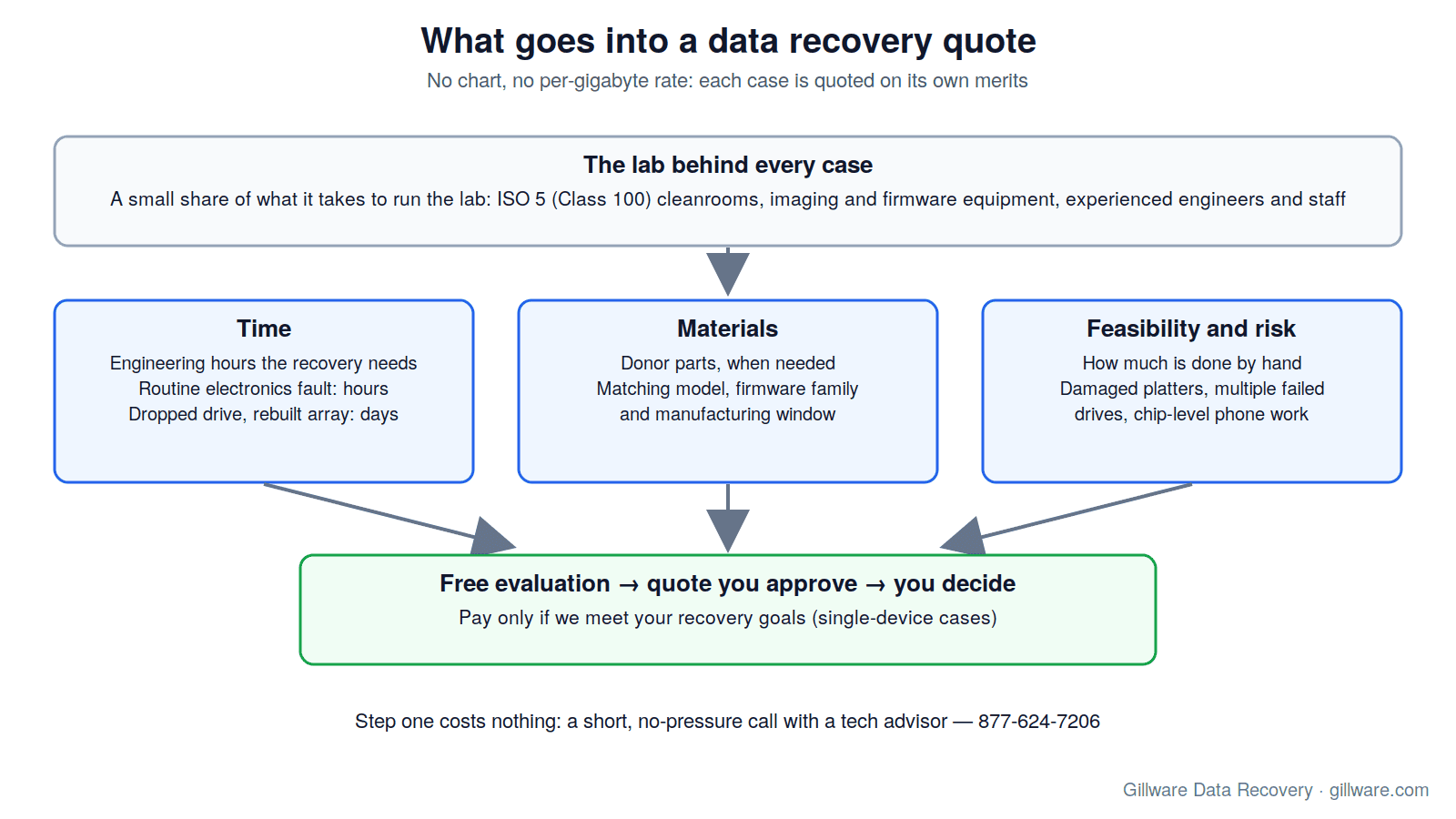
Every case carries a small share of what it takes to run the lab: the cleanrooms, the equipment, the experienced engineers and the staff who handle intake, shipping and quality control. On top of that, each quote reflects a blend of three things.
Time
How many engineering hours the recovery needs. A drive whose electronics failed may be reading again the same day. A drive that was dropped while running, or an array that was rebuilt onto the wrong disks, can take an engineer days of careful work before a single file comes back.
Materials
Whether the recovery needs donor parts. Many mechanical recoveries require a matching donor drive for head or motor components, and a close match matters: same model, same firmware family, often the same manufacturing window. Some models are plentiful; others are rare and have to be sourced specifically for your case.
Feasibility and risk
How much risk the recovery carries, and how much of the work has to be done by hand. Cases with more risk or more engineering hours — damaged platters, multiple failed drives in an array, a phone whose board needs chip-level work — are quoted higher than routine ones, because they genuinely take more of the lab’s most limited resource: an engineer’s attention.
None of this is worked out from a chart. We quote each case on its own merits, based on what we find in the lab and the thousands of similar cases we have seen with the same equipment and symptoms. That experience is what lets a tech advisor give you a realistic idea on the phone before you ship anything, and what lets the lab give you a firm number after the evaluation.
Have the device type and the symptoms handy, and a tech advisor can give you a realistic idea of cost in a few minutes.
How to Get Your Number
Getting a real cost for your recovery is a two-step process, and the first step costs you nothing but a phone call.
- A friendly call with a tech advisor. Tell us what the device is, what happened, and what you most need back. Our advisors have heard thousands of versions of this story, and they can usually tell you right away whether your case looks routine or involved, and what that tends to mean for cost. There is no pressure and no obligation.
- A free in-lab evaluation. Ship the device to us. Our engineers diagnose exactly what failed and confirm what can be recovered. The evaluation is real engineering work, not a form, and it is free.
- A firm quote you approve. Every case is quoted after a free evaluation, so you know the cost before any recovery work begins. You decide. On single-device cases, you only pay if we meet your recovery goals — and those goals are agreed with you in writing before the work starts.
If you decide not to proceed, your device is returned to you (return shipping applies) or securely recycled at no charge.
What Changes the Cost, Device by Device
Each device type has its own cost drivers. The pages below walk through them in detail; here is the short version.
Hard drives
The biggest single factor is whether the drive needs cleanroom work. A drive that is not recognized because its circuit board or firmware failed is a very different job from one that is clicking, which almost always means the read/write heads are damaged and the drive has to be opened. Whether the platters were scratched, whether a matching donor is available, and how much of the drive can be imaged before it degrades all shape the quote. See hard drive data recovery.
RAID, NAS and servers
Multi-drive cases scale with the number of drives, the RAID level, and — above all — what was done to the array after it failed. An array that was powered down and shipped intact is a reconstruction job. An array that was rebuilt, re-initialized or forced online is often a recovery of a recovery. Business cases usually start with a free technical consultation with one of our enterprise storage engineers, and you approve all recovery fees in advance. See RAID data recovery.
SSDs and flash
SSD cost is driven by the controller and the firmware. Many SSD failures are firmware or mapping-table corruption, and some models can be brought back at the firmware level; others use encryption and signed firmware that make recovery expensive or impossible, and we say so plainly rather than guess. See SSD data recovery.
Phones
Phone recovery is board-level, chip-level work under a microscope. Many phone recovery cases are financially risk free. The best way to estimate recovery costs and whether there are any potential parts fees is to speak with a recovery advisor and have your model phone and symptoms handy. See phone data recovery.
Why Choose Gillware
Gillware has been recovering data for more than two decades from our lab in Madison, Wisconsin. More than 1,500 IT professionals nationwide refer their clients to us, which is the kind of trust that only comes from sending someone a hard case and getting it back. Our highly experienced engineers strive for the highest success rates in the industry, and our data recovery lab is built around one job: getting your data back safely, and telling you the truth about cost and odds along the way.
Data Recovery Cost FAQ
Can you give me a price over the phone?
A tech advisor can give you a realistic idea once they know the device and the symptoms, and that is usually enough to decide whether to send it in. The firm quote comes after the free evaluation, because that is when we actually know what failed.
Is the evaluation really free?
Yes. On single-device cases there is no charge for the evaluation. Business and multi-drive cases start with a free technical consultation with an enterprise storage engineer, and all recovery fees are approved by you in advance.
What if you can’t recover my data?
On single-device cases, you only pay if we meet the recovery goals we agreed on with you in writing. If we cannot, the device is returned to you (return shipping applies) or securely recycled at no charge.
Does the amount of data change the price?
Not in the way people expect. The work is in getting the drive to read and the file system to make sense again, not in copying files. A drive with a small amount of data and a failed head stack is just as much work as a full one. That is why we do not quote per gigabyte.
What separates a professional lab from a bargain one?
An engineer evaluates every case, the quote is based on what was actually found, the work happens in a real cleanroom with the right donor parts, and the agreement is in writing before anything starts. The thing to protect is the one copy of your data: an unsuccessful first attempt by someone without those resources is the most common way a recoverable drive becomes an unrecoverable one.
Will my data be secure?
Yes. Your media is handled in a secure facility with controlled access, recovered data is returned on an encrypted drive, and our working copies are securely destroyed after your case closes.
Start With a Conversation
You do not have to decide anything today. Call 877-624-7206 and tell a tech advisor what happened, or start a case online and we will call you. Either way, you will know what your recovery is likely to involve before anything ships.
Want a real number for your case? Let’s talk.
Our highly experienced engineers strive for the highest success rates in the industry. Send us the device and we’ll diagnose it for free.
- More than 20 years recovering data from failed drives
- Trusted by 1,500+ IT professionals nationwide
- Whatever failed, we’ve seen it hundreds of times
- Pay only if we meet your recovery goals