
WD Easystore, My Passport or Elements Not Showing Up? What to Check

WD drive not showing up?
If checking cables, ports and Disk Management doesn’t bring it back, stop there. Our engineers will evaluate the drive for free.
As with any USB attached external hard drive, a Western Digital failure or hard drive not recognized error may occur for a number of reasons. If you are experiencing issues with your WD external hard drive, don’t worry, you are not alone, and the Gillware data recovery experts are specialists in recovering data from a WD external hard drive.
This guide covers the Western Digital external drives we see most often when they stop showing up: WD My Passport, WD My Book, and WD Elements and Easystore drives. It walks through the safe checks worth trying first, the fixes that can make things worse, and when to stop. For the bigger picture on how WD drives fail, see our Western Digital data recovery page.
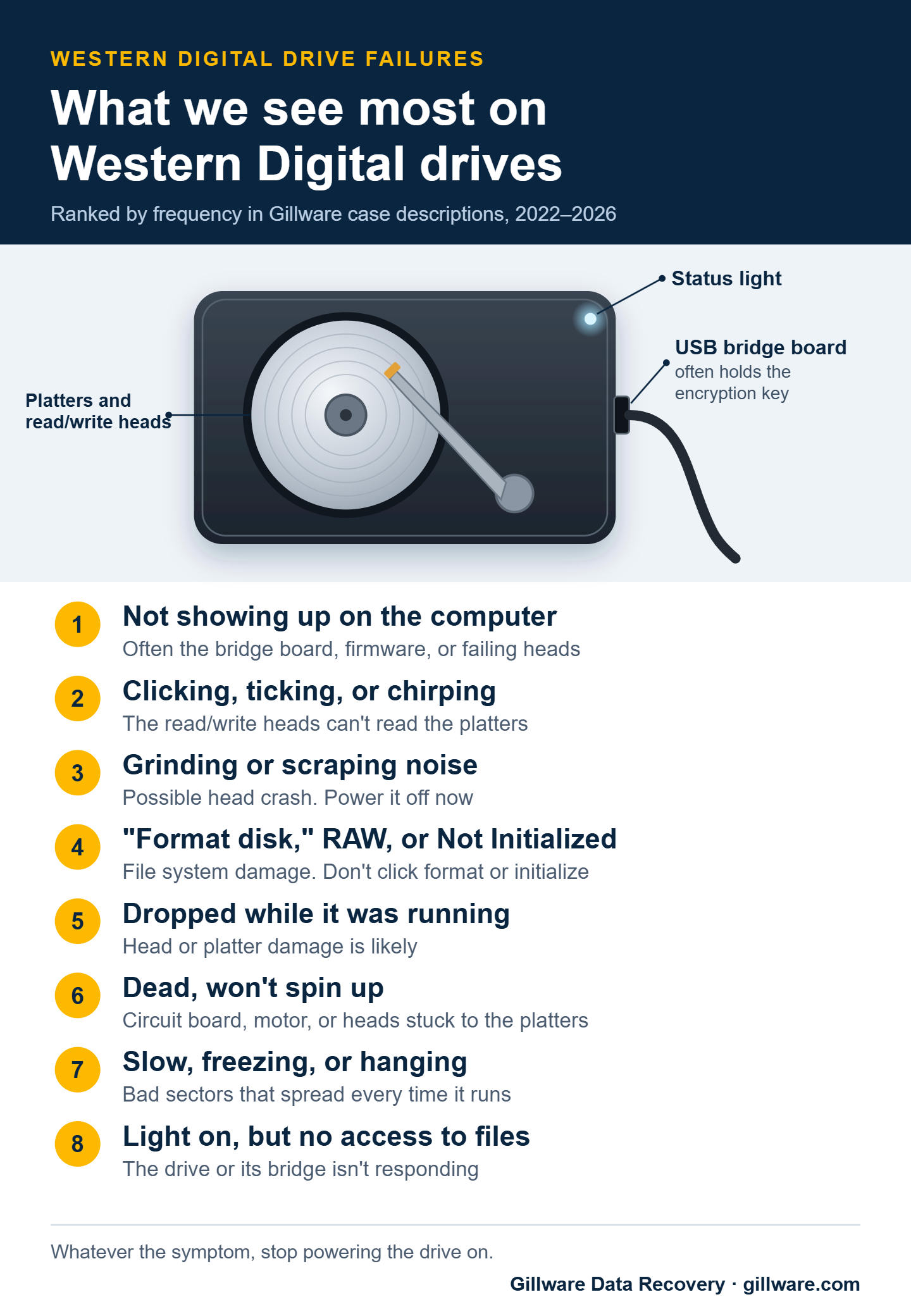
Why is my WD external hard drive not showing up?
There are many reasons for a WD external hard drive not working when attached to your computer. The fault could be with the computer, the WD external hard drive itself, or even the cabling. No two WD external hard drive issues will be the same, but the good news is the majority of issues can be fixed.
Here are some possible reasons for a WD hard drive not recognized:
- A hardware problem (damaged components such as a scratched platter or a failed headstack)
- File system corruption of the hard drive partition
- Issues with a hard drive partition
- Insufficient power supply to the WD hard drive
- Windows is unable to allocate a hard drive letter
- Outdated or corrupt hard drive driver (download and install the latest driver to update WD)
- A fault with the USB port on the computer or USB device
- Faulty cables
WD drive still not recognized? Our engineers will diagnose it for free in our Madison lab.
How can Gillware help to recover your WD easystore?
At Gillware, our expert data recovery engineers recover data from failed hard drives (including all WD hard drive types), flash drives, and more in ISO 5 certified Class 100 cleanroom benches. We utilize cutting-edge proprietary technologies and recovery software of our own design, such as our intelligent forensic imaging software and hard drive platter burnisher.
Our data engineers and data scientists have recovered customer data from some seemingly impossible scenarios; fire and water-damaged media are not uncommon, but it can be a painstaking process for our experts to rebuild the data for the client. Usually, this involves stripping the disk’s internal components, repairing disk platters with our burnishing tool, and then rebuilding the disk using spare parts from our extensive spare part library. Our library of spares is extensive, featuring most makes and models (including WD hard drive models), and each part is carefully cataloged by our data recovery experts, allowing us to audit what parts are in stock and available for our data recovery services.
Gillware runs a secure data lab that maintains the confidentiality of clients of all sorts, including the healthcare industry and government agencies on the federal, state, and local levels. We are proud of the relationships we have built with our healthcare and government partners, and their support is one of the most crucial elements of our data recovery company.
When experiencing a “hard drive not recognized” error, a WD hard drive user can perform several initial checks completed to rule out issues with the computer/laptop, Windows 10, or the USB drive, power adapter cable, or USB port.
Step 1 – Check your PC power saving settings
If you have Power Saving options enabled on your PC or Laptop, there is a chance that Windows has switched off the root hub to save power. This can be fixed from the Windows Device Manager.
- From the Start Menu type “devmgmt.msc” to open the device manager
- Scroll down the list of hardware until you find “Universal Serial Bus Controller,” then expand the list
- At the USB root hub, right-click and select properties
- Look for the power management tab and ensure the checkbox for “Allow the computer to turn off this device to save power” is unchecked. You may need to repeat this process if you have more than one root hub
- Reboot your computer to apply the fix, and if needed, you can open device manager to check the settings have saved
Step 2 – Check if Windows 10 or macOS can see the disk
With most Operating Systems, there is an automated routine that will cause a pop-up display when you have connected a USB external hard drive. We will assume that when you connect your WD easystore, you are not seeing any immediate activity from Windows 10 or macOS.
For a Windows 10 PC, you need to check an application called Windows Disk Management.
- Click the Windows 10 start menu
- Type “diskmgmt.msc” and you should see a Disk Management Icon appear; click on it to open the application
- On the Disk Management application, you will see a list of all your computer’s internal and external storage devices. This will show internal mechanical hard drives, SSDs, external USB hard drives, flash drives, pen drives, and DVD ROM drives. Anything connected to your PC will show up here
- Hopefully, your WD Hard Drive shows up here. Right-click on it and click “change drive letter and paths” and follow the instructions to assign a drive letter to the external hard drive
- If the drive shows up as “Unknown” and “Not Initialized,” stop. Don’t initialize it, and don’t accept any prompt to format it. Initializing writes a new partition table over the old one. Power the drive off and leave it off.
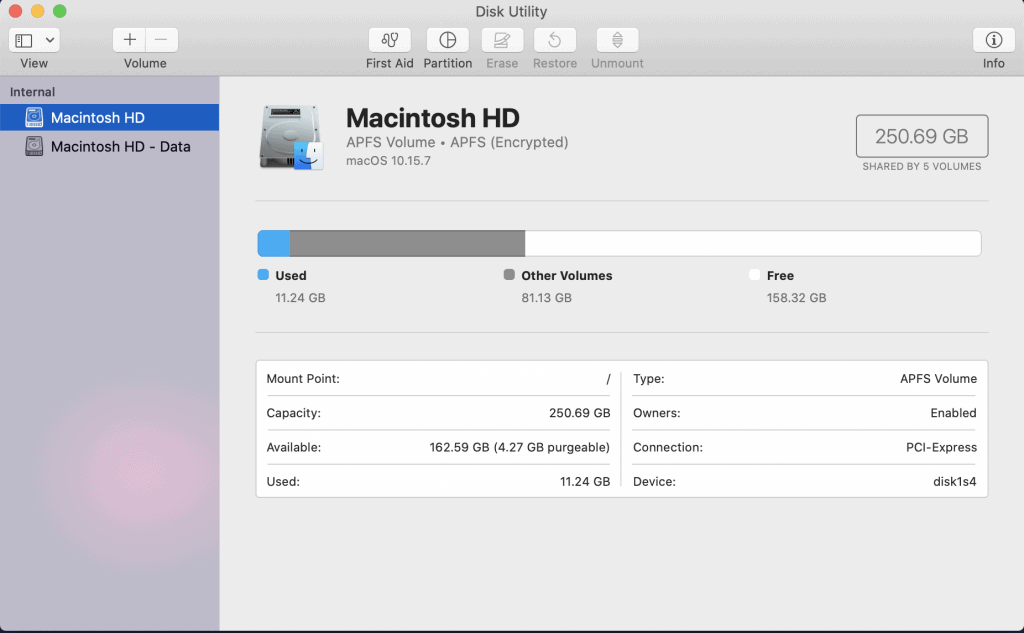
For a Mac, the Apple version of Disk Management is called Disk Utility.
- Use the Mac finder search tool to find “Disk Utility”
- Once open, choose View > Show All Devices and look for the WD hard drive in the left-hand pane. If you can’t see it here, macOS can’t see the drive either. If it appears but won’t mount, don’t run First Aid over and over; repeated repair attempts add wear to a failing drive
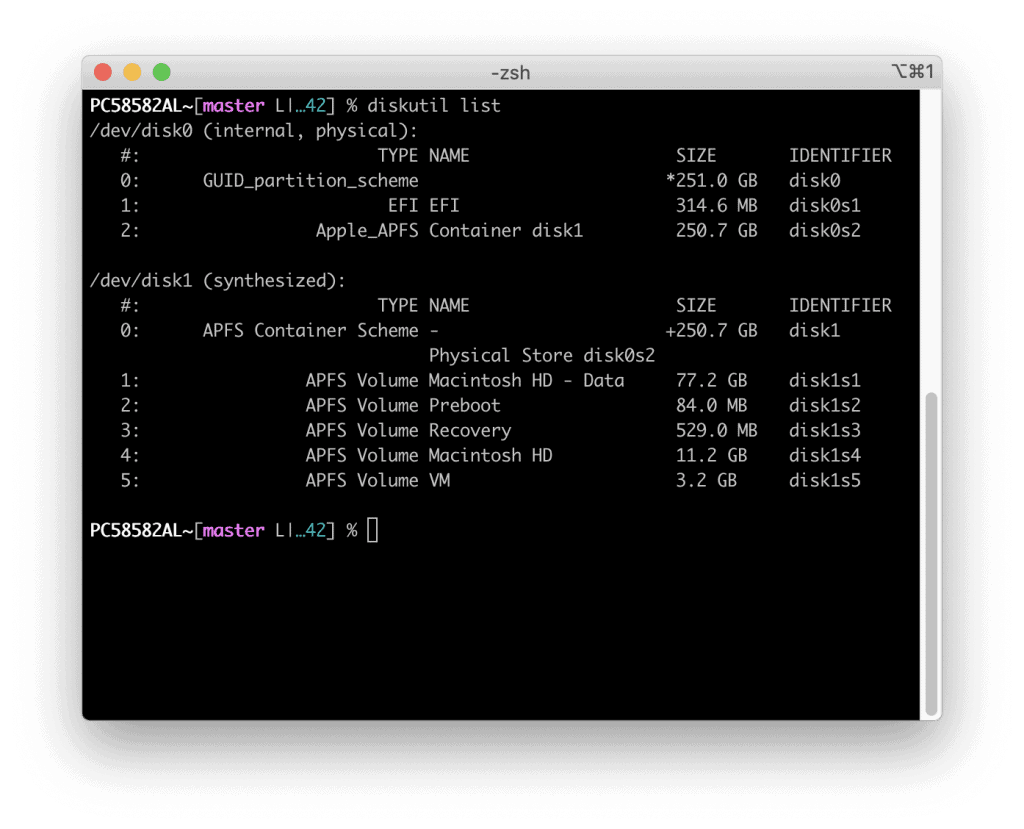
- You can sanity check by opening up the terminal and typing diskutil list
Step 3 – Check your cables
In some rare instances, an issue with the WD external hard drive USB cable or power cable is the culprit. First, check the power cable, trace the cable to the power adapter making sure there is no damage to the cable, and that the power adapter is plugged in and switch on at the wall outlet.
Double-check that your WD easystore power light comes one, hopefully, you will see flashing LEDs with activity. If not, try and source a replacement power cable, they are usually 12v – but check your WD external hard drive product support warranty.
Next check the cable that connects the WD external hard drive to the PC or Mac. Ensure both ends are securely attached and check for any signs of damage to the cable. Is the USB port connector damaged, bent out of place, or maybe snapped off?
Move the USB cable to free USB ports on your PC, does Windows 10 or your Mac recognize the WD Hard Drive? If not, try replacing the USB cable if you have a spare one lying around the house.
Quick checks by WD model
WD My Passport (portable)
Use the short cable that came with the drive and plug it directly into the computer, not into a hub, dock, or front-panel port. Portable drives draw all their power from the USB port, and long cables or hubs can leave them underpowered. If the light comes on but the drive clicks, chirps, or never mounts, stop there. On many newer My Passport models, the USB port is built onto the drive’s own circuit board, so a loose or damaged port isn’t something to wiggle back into place. More on WD My Passport data recovery.
WD My Book (desktop)
My Book drives need their own power adapter. Check that the adapter’s light is on and that it’s the original adapter, or one with exactly the same voltage and polarity; the wrong adapter can damage the board. If Disk Management shows the drive as “Unknown” and “Not Initialized,” or with the wrong capacity, don’t initialize it. That’s usually the bridge board or the drive itself, not Windows. More on WD My Book data recovery.
WD Elements and Easystore
Desktop models run on a power adapter and portable models run on USB power, so use the matching checks above. Some Elements and Easystore drives don’t use hardware encryption, which is why online guides suggest “shucking” them out of the case. Don’t do that with a drive holding data you need: opening the case voids the warranty, and if the drive inside is the part that’s failing, every extra power-on makes recovery harder. More on WD Elements and Easystore data recovery.
It shows in Device Manager but not in Disk Management or Finder
This is the most common version of the problem we hear about. The computer can tell a USB device is attached, but it can’t read a usable drive behind it. That usually means the bridge board can’t talk to the drive, the drive’s firmware is hanging, or the read/write heads can’t read the drive’s own service data. Updating drivers or reinstalling WD software won’t fix any of those. If you’ve already tried another cable and another port, power the drive off and leave it off.
If you have no luck, then unfortunately your WD hard drive is inaccessible. You can either attempt a home fix (not recommended) or get the disk sent to the data recovery experts at Gillware to recover your lost data.
How do I fix an unresponsive WD external hard drive?
The first decision you must make is if you want to attempt a home fix or get the WD hard drive sent to a data recovery company like Gillware. Make your decision based on how important the data is to you. We highly recommend choosing expert data recovery for your WD hard drive, as attempting to fix WD hard drive problems with recovery software or another method can make the data on the drive inaccessible and even make the data loss permanent.
If the data is critical to you, such as treasured family photographs or essential business data, then for the best possible outcome, you need data recovery experts like Gillware to help recover your lost data.
Why pulling the drive out of the case usually doesn’t help
Many online guides suggest opening the enclosure and connecting the drive inside directly to a computer. We don’t recommend it. On many My Passport and My Book drives, the USB bridge board in the enclosure encrypts everything written to the drive, so a drive connected directly reads as scrambled data even when it’s perfectly healthy. Many newer portable models don’t have a separate drive inside at all; the USB port is built onto the drive’s own circuit board. Opening the case also voids the warranty, and if the drive itself is the part that’s failing, it gets one more power-on it may not survive.
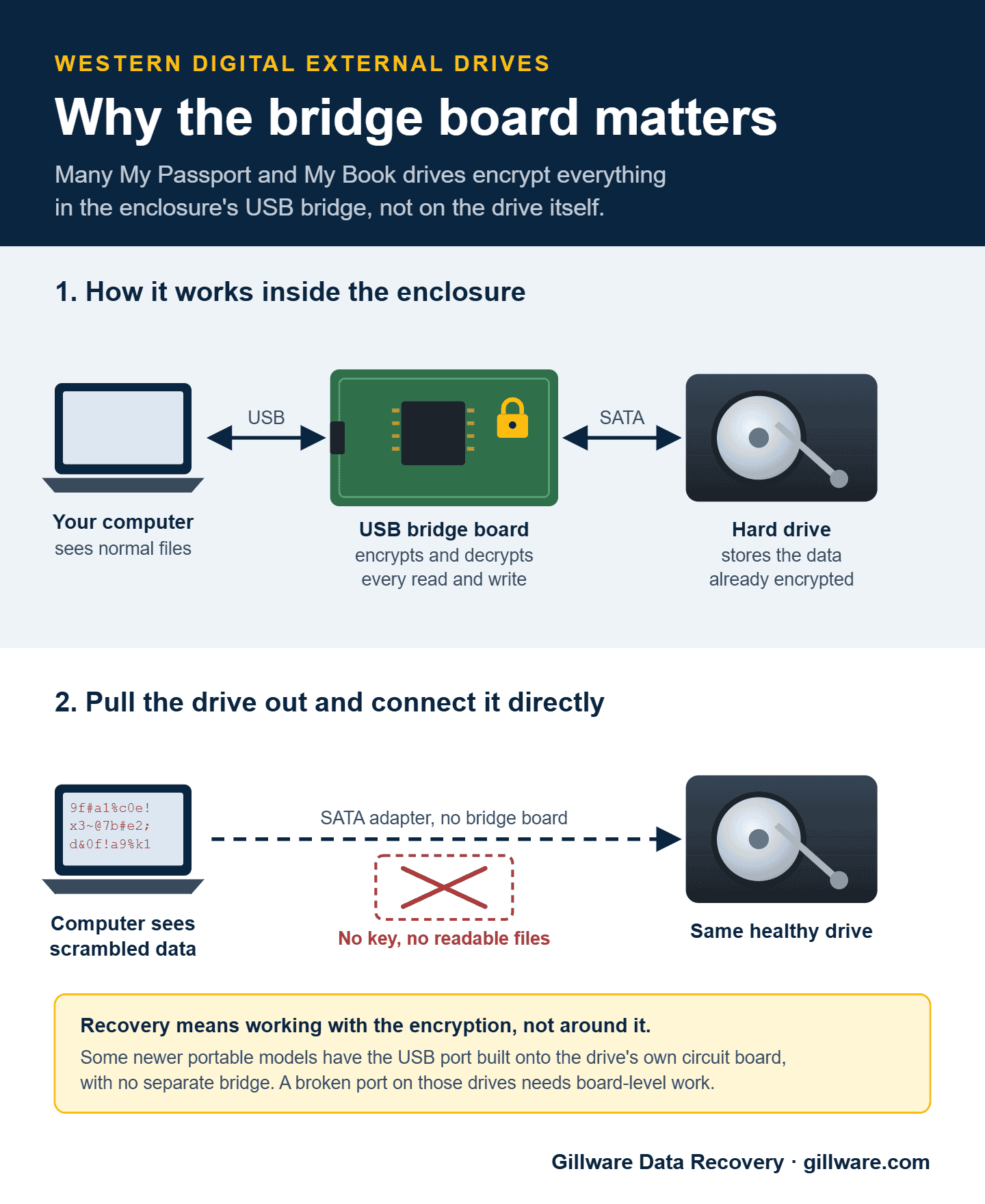
If the data matters, the safer move is to stop after the non-invasive checks above and have the drive evaluated by a lab with the tools to handle the encryption correctly.
How do I fix my WD easystore?
When all else fails, Gillware is here to solve your data loss problem
Once you reach out to Gillware customer support, we’ll send you a free prepaid shipping label for standard single-device cases in the continental U.S. Upon arrival to the Gillware Lab here at Madison, Wisconsin, your WD hard drive will be cataloged and then examined by our Data Recovery Experts. The initial assessment will determine the cause of the fault, and we will determine the probability of successful WD drive data recovery.
Our experts will make contact with the client to discuss the data recovery options, and upon approval, we will start the recovery process. Each fix varies. If a logical repair is possible, our in-house software will pull and rebuild the data off the drive. If any internal components are damaged, we can use our spare parts library to rebuild the drive at Gillware’s cleanroom benches.
You can trust Gillware for all your data loss needs.
WD drive still not showing up? Let’s get your files back.
Our highly experienced engineers strive for the highest success rates in the industry. Send us the device and we’ll diagnose it for free.
- More than 20 years recovering data from failed drives
- Trusted by 1,500+ IT professionals nationwide
- Whatever failed, we’ve seen it hundreds of times
- Pay only if we meet your recovery goals
